
FICC 0.3.0.dev1 nightly / cluster control and inference
A connected cluster workspace.
Manage cluster operations, model storage and inference services from one controller.
The first 0.3.0 nightly adds managed local inference and HyperNet federation to the existing cluster workspace. Configure the relevant services, accounts, runtimes and grants before using a workflow. Stable 0.2.6r4 remains available on the download page.
Managed local inference
Select a verified model, an approved contributor and an engine. Reserve GPUs, start the service, inspect health, stream responses and stop it through the UI, CLI or API. Modular adapters support llama.cpp, Ollama and optional vLLM through their supported interfaces.
Multiple GPUs on one contributor can host a model when the engine supports it; separate contributors can run replicas. Cross-host tensor parallelism is not supported. Managed inference is qualified on Linux with NVIDIA GPUs. Engine images and model weights are separate, explicitly approved downloads.
Inference setup and operation → Engine deployment → Inference provider SDK →
Models, weights and storage
Import model manifests, verify file digests and manage storage roots and contributor caches. Capacity checks and retained transfer state support large weights without treating a partially transferred file as ready. Choose storage with enough room for staging and completed files.
Keep durable controller state separate from bulk model and task storage. Back up before upgrading; rollback needs a matching pre-upgrade database backup. Restored inference and federation state requires explicit reconciliation before work resumes.
Model manifests → Storage → Recovery →
Federation through HyperNet
Pair clusters through separately configured HyperNet Core and Suite 0.9.0. Publish selected inference services, route requests and delegate explicitly granted lifecycle operations. Transfer verified model files across the connection with pause and resume.
Scoped client credentials, project assignments and federation grants define access. Revocation cancels active remote requests. Pairing does not grant unrestricted cluster access. HyperNet remains an independent networking system; FICC uses its reusable application streams and SDK.
Pairing, grants and operation → Federation interfaces →
Installed agents and machine-first launch
FICC scans enrolled Linux and macOS accounts for supported command names, including Codex, Claude Code, Pi, OMP, Kimi Code, OpenCode, GitHub Copilot, Gemini CLI, Grok and Cursor Agent. Discovered profiles retain their identities across scans and use the account home as their initial workspace. Matching manual profiles retain their custom workspace.
Choose a machine before choosing its agent. Refresh updates installed commands while slower machines finish independently. Preview shows the command, workspace, version and delivery method. Back preserves the selected machine, profile, bus run and label before submission; an uncertain launch keeps its original retry identity.
Discovery does not install agents, sign in to providers, select a model or qualify direct delivery. OMP and Codex retain their version-specific adapters; other commands use the generic inbox workflow. Agent tools retain the runtime account's authority.
Discover, preview and launch an agent →
Native macOS and coding agents
Mac nodes report native CPU, memory, disk and network readings and support SSH shells, tmux terminals and coding agents. Mac controllers use a private local socket and on-demand per-user launchd startup. Native CI covers Apple Silicon and Intel macOS, plus Linux.
Generic, OMP and Codex profiles share the inbox, explicit reply tools, terminal attachment and stop/archive workflow. Qualified versions enable direct delivery; other versions retain inbox delivery. Real OMP extension/RPC and Codex startup/session checks use no provider credentials or model inference.
Managed resource-limited jobs, safe file roots and executable module containment retain their Linux requirements. Linux native viewer bundles, controller-local file roots and Linux-oriented backup/export are not qualified on Mac. Agent tools retain the account's authority.
macOS setup and limits → Qualified agent versions →
Agent observations and GPU readings
A continuing agent session can list its approved Linux SSH machines and read saved resource samples through a fixed JSON CLI and HTTP interface. Separate observation-only tokens, current project assignments and runtime policy constrain access. Authorized disclosures and denials are audited. This interface does not provide execution, refresh, file or log access.
Generic AMD monitoring reads available amdgpu sysfs and hwmon attributes without ROCm, sudo or device control permissions. Unknown readings remain null. AMD devices are observation-only and cannot enter CUDA reservations. Reported observation checks cover an AMD Raphael integrated GPU and an Apple M5 Pro. Discrete AMD cards, including the RX 590, and wider hardware combinations remain unqualified.
Apple Silicon GPU readings use bounded IORegistry queries without a privileged daemon. Available utilization and used unified memory are shown; total GPU memory and temperature remain unknown. Shared system memory is not dedicated GPU capacity. Intel Macs without an AGX accelerator report Apple GPU observations as unsupported.
Approve which observation fields may reach the agent and its inference provider. The interface cannot recall released information or constrain an agent's independent tools and credentials.
Agent observation interface → GPU observation coverage → Security model → Project contributors →
Themes and materials
Choose from 26 built-in themes: the original Classic Light, Classic Dark with AOTX PRISM Graphite colors, and 24 additional palettes. Search and filter the catalogue, preview a selection immediately, and export its complete JSON definition. Import a custom palette with adjustable gradients, a background grid and a logo built from vector paths.
Flat materials disables all material gradients and the grid. Preferences stay in the current browser origin and follow separate workspace windows. Restore Classic Light keeps imported themes available. The update also improves narrow navigation, control alignment and floating-panel restoration.
Appearance and theme format → Gradient example → Custom-logo example →
Theme gallery
Six palettes from the built-in collection, plus the appearance controls and a custom logo example. Open an image to explore the full console.
Actual FICC interface captures. The displayed records are illustrative.
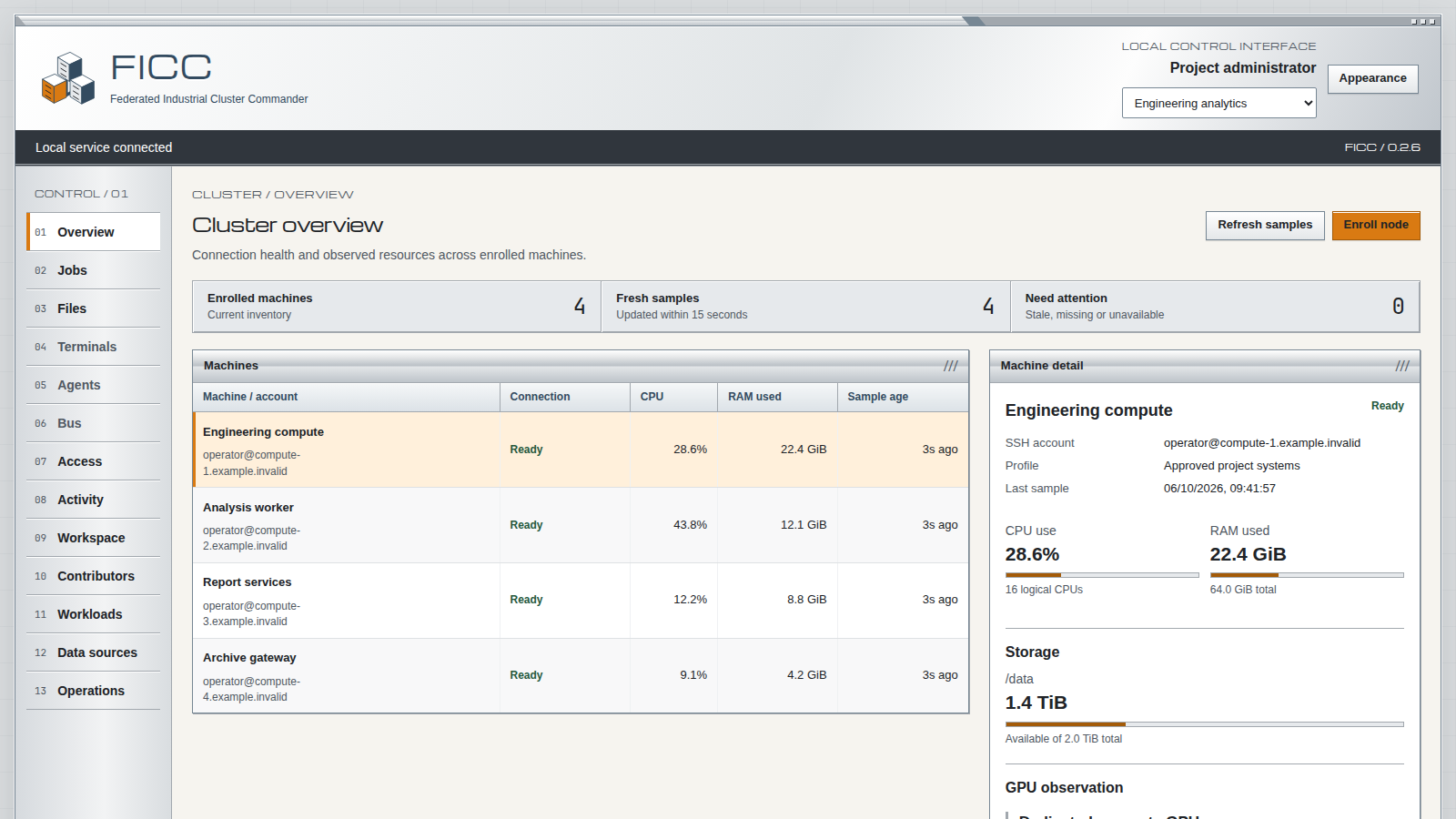 View full size
Classic Light
The original silver console, warm paper and industrial orange.
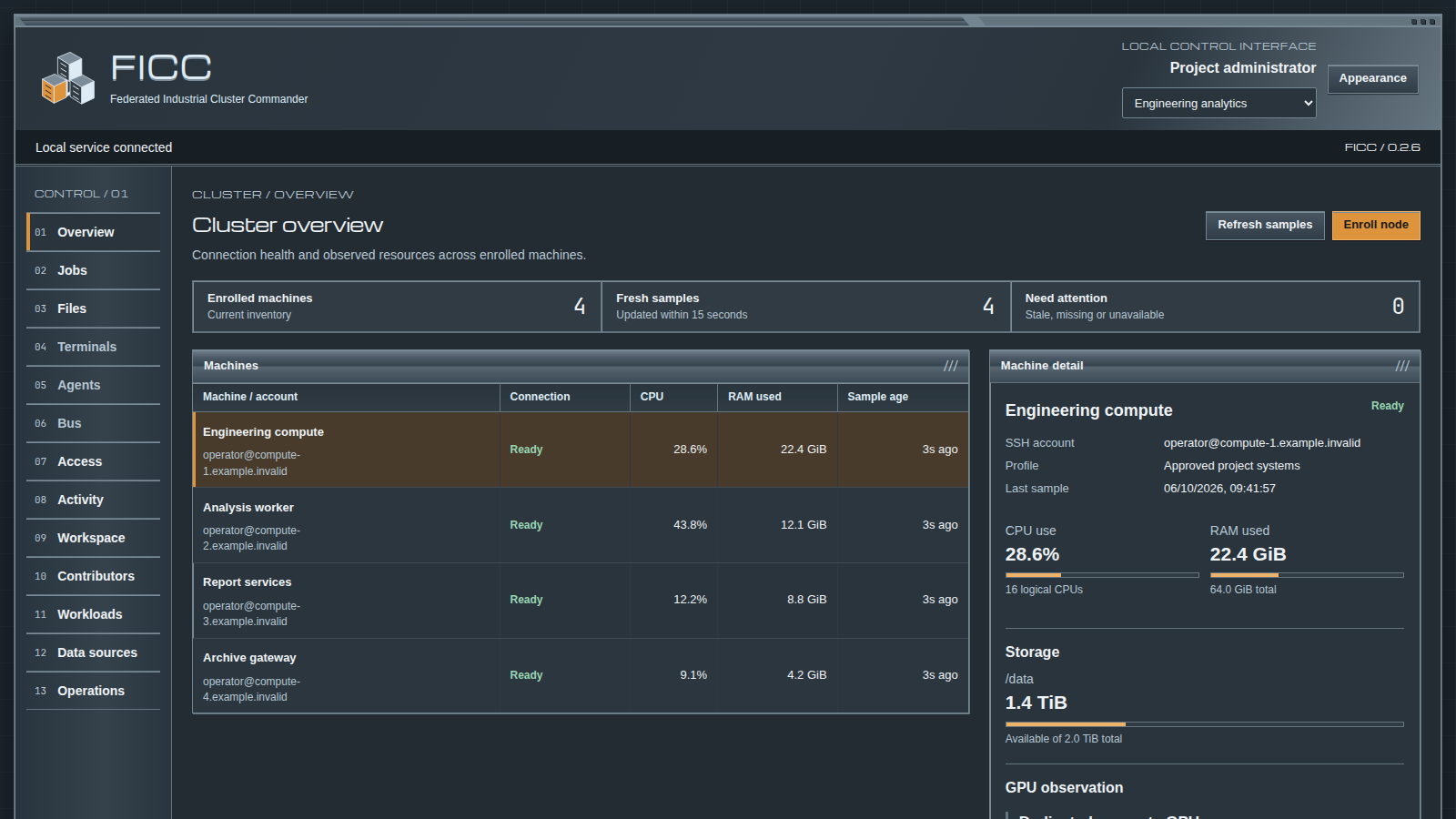 View full size
Classic Dark
PRISM Graphite: blue-grey metal, pale text and warm orange.
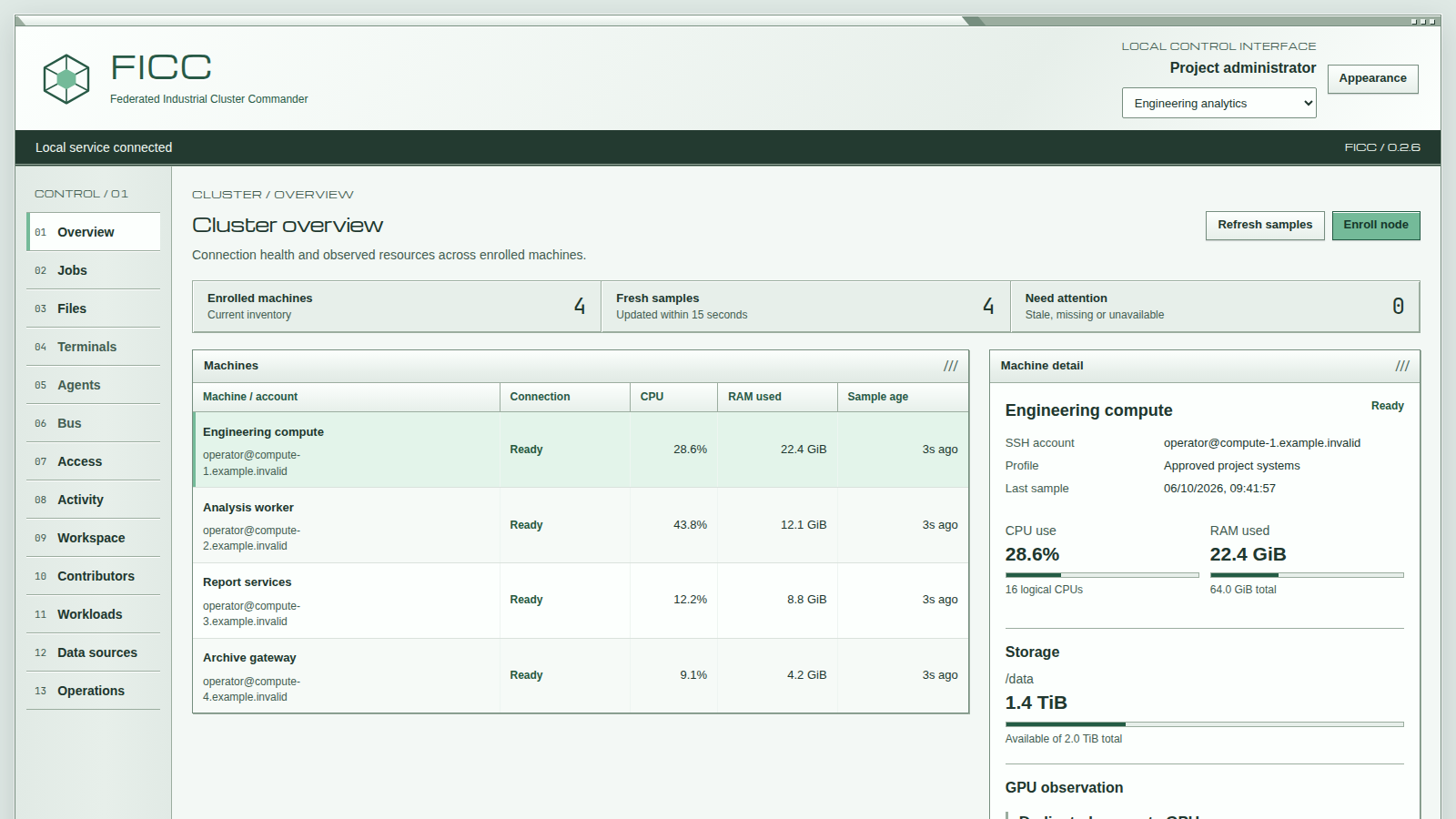 View full size
Porcelain Circuit
Soft porcelain, jade controls and quiet silver edges for a clear working day.
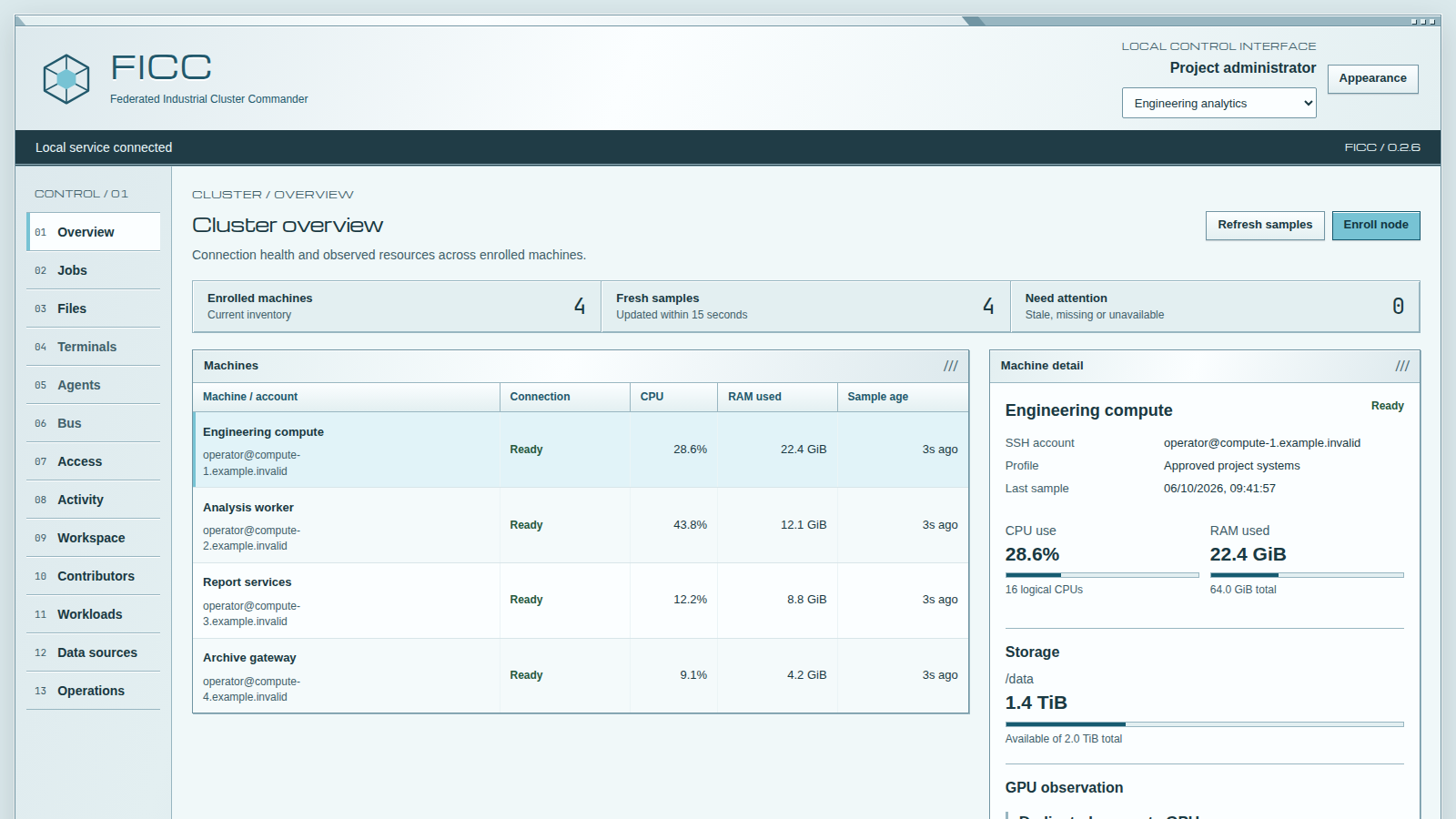 View full size
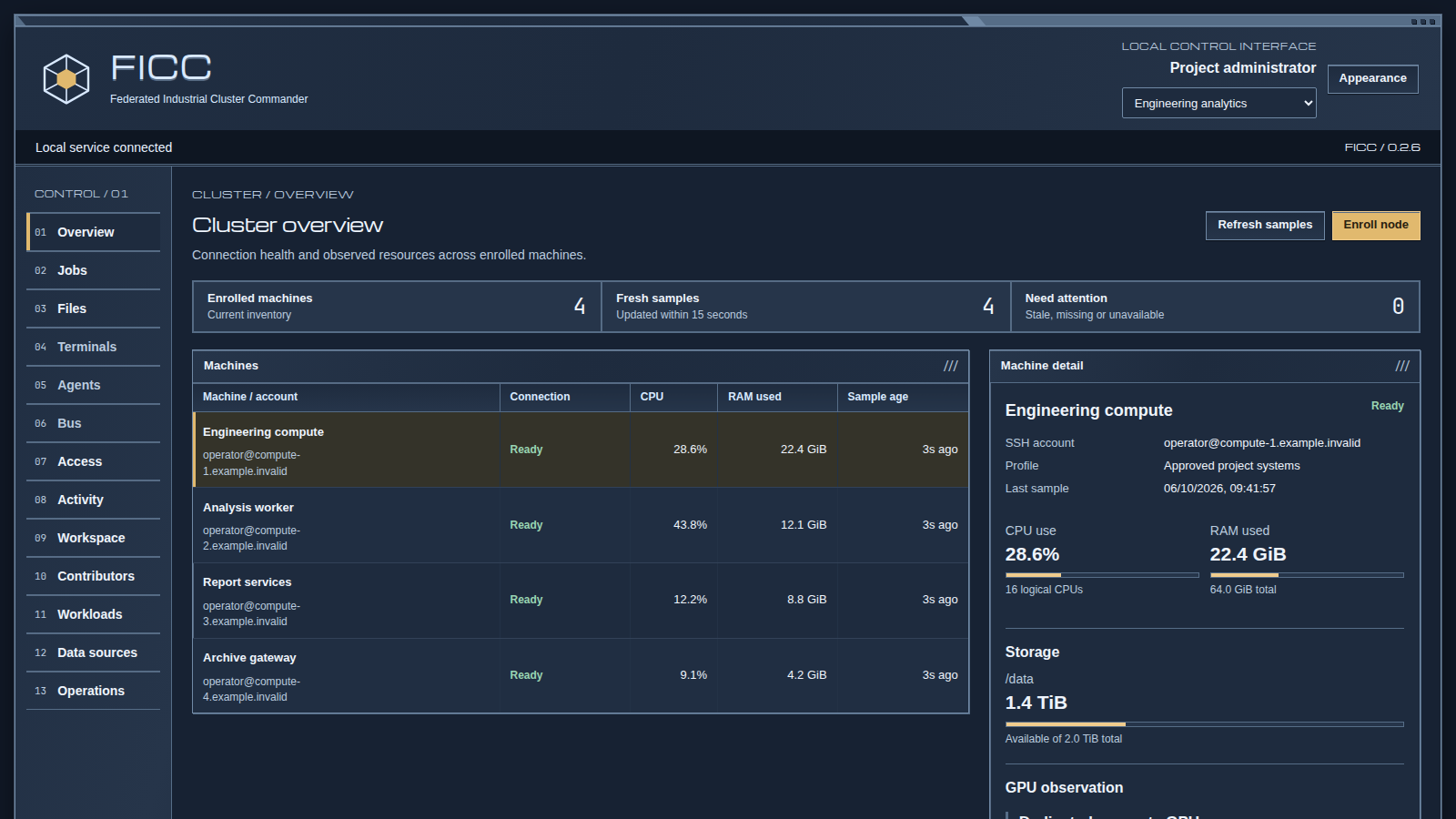
Saltwater Atlas
Sea-glass surfaces, tidal blue and chart-room clarity.
 View full size
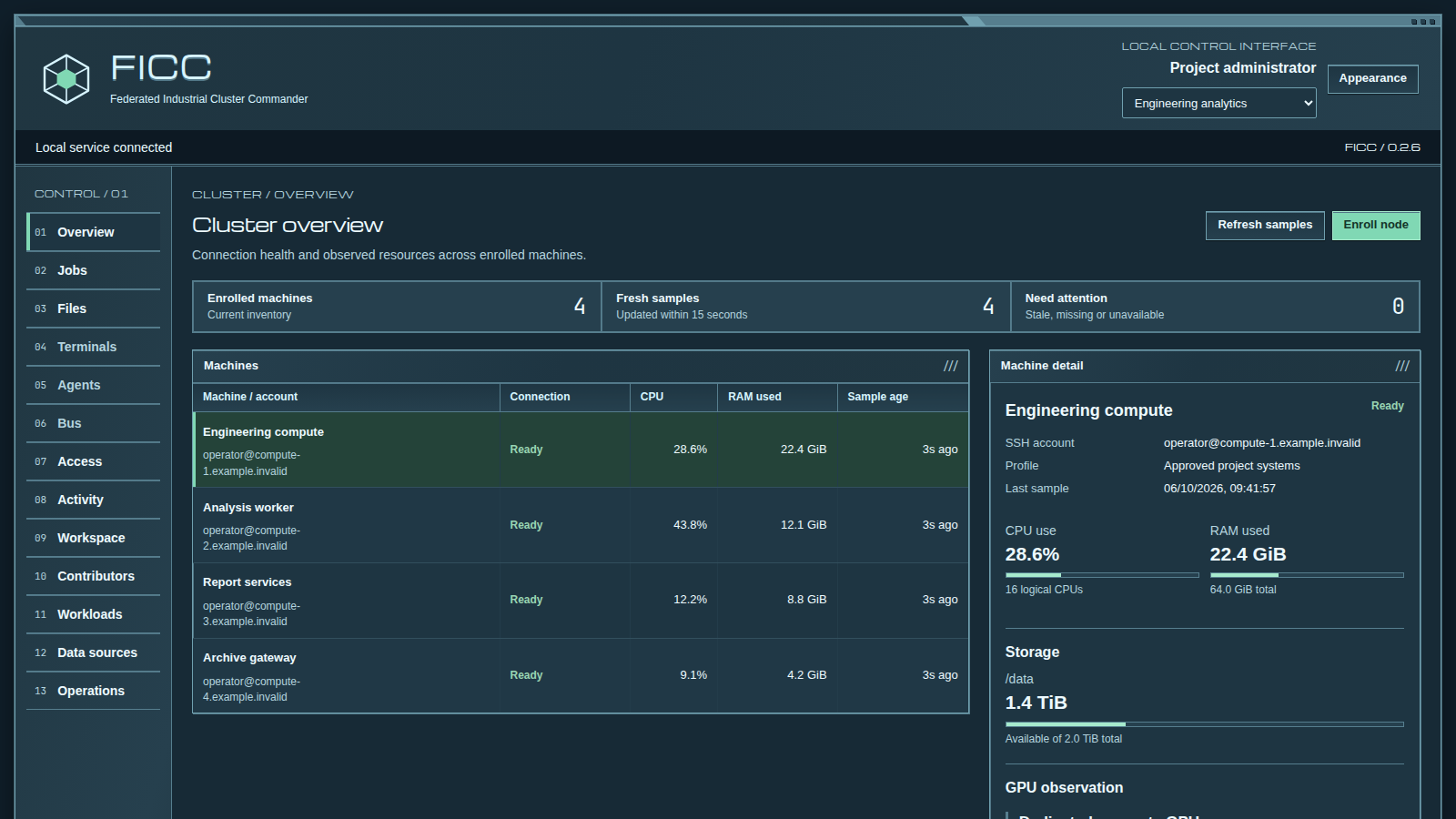
Midnight Observatory
Deep navy instruments and warm starlight for the late watch.
 View full size
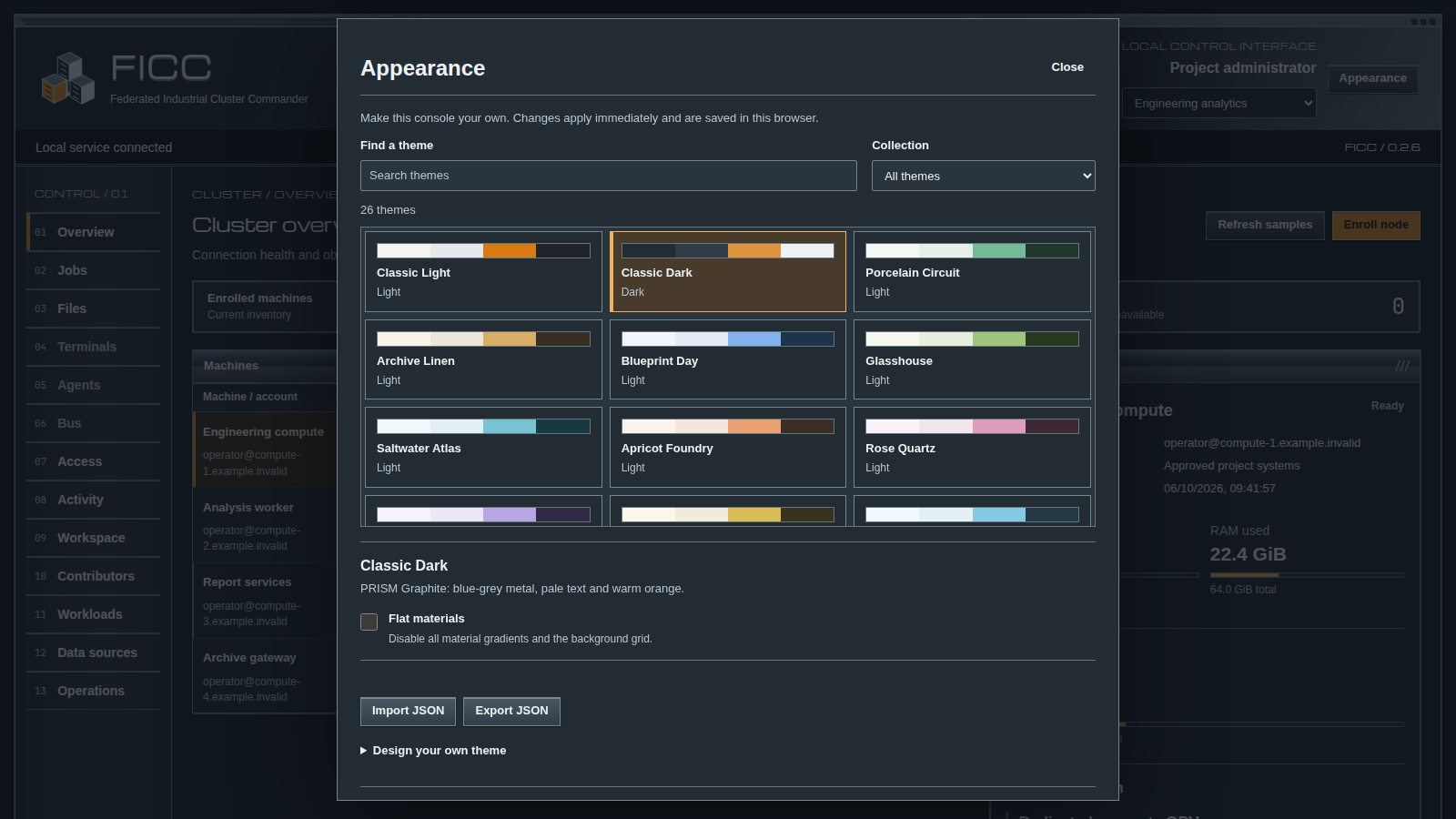
Polar Aurora
Arctic blue night crossed by green aurora and pale glacial type.
 View full size
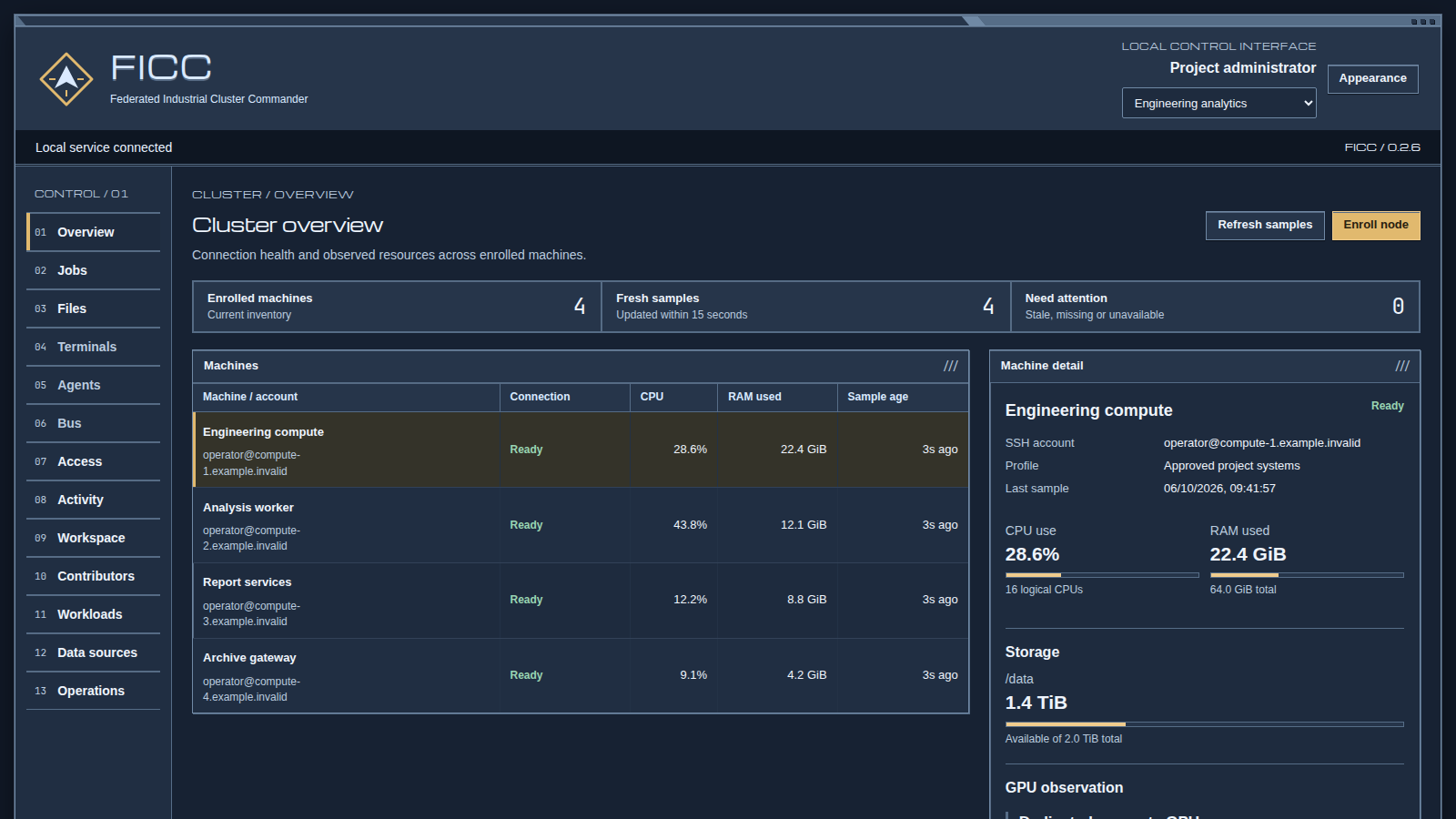
Appearance
Choose a built-in palette, import and export theme JSON, and select flat materials.
 View full size
Beacon Custom
The supplied JSON example replaces the palette and vector logo.
Projects and remote access
Durable identities, project membership and resource assignments define access. Signed policy packages support effective-access previews, activation, rollback and revocation. Local mode stays on loopback. The separate remote profile uses an HTTPS gateway, approved external identities and MFA; identity-service membership alone grants no FICC access.
Projects and identities → Runtime policies → Remote access →
Contributor workloads
Approve a contributor identity and its offered resources, select an installed runtime, then submit work to a project queue. Contributor execution enforces CPU, memory, process and finite storage limits under renewable authority. Complete physical GPUs are selected by UUID. Local voluntary owners can pause, drain, stop or resume contribution within the installed ceiling.
The supplied runtime shares the Linux kernel and has no workload network. It does not promise fractional GPUs, VRAM quotas or isolation from the machine administrator. Sensitive data requires approved managed nodes. Lost authority stops work through the lease protocol; uncertain outcomes and unconfirmed cleanup remain visible.
Contributor approval → Queues and results → Execution limits →
Files, datasets and result publication
Browse registered roots and transfer files in bounded chunks without a fixed 16 GiB total-file ceiling. Resumable operations bind an immutable source identity and digest, reserve destination capacity and verify completion. Capacity, quotas and filesystem limits still apply.
Dataset versions record file identities, complete digests, schemas and provenance. A mutable source is verified again before use. Workload inputs and published outputs currently relay through the controller. Completed output can become a registered file and dataset with host-bound workload lineage; unknown publication outcomes require explicit recovery.
Verified transfers → Dataset versions and lineage →
Data sources and formats
Register approved SQLite, PostgreSQL or MySQL/MariaDB connections, bind query parameters, inspect a bounded preview and export a dataset. Separate providers handle CSV, Arrow, Parquet, local DuckDB queries and S3-compatible reads and multipart publication. Read, export and write authority are distinct.
Restricted database accounts enforce actual server rights. Uncertain transaction commits are never replayed automatically. Endpoint identity, verified TLS and secret references belong to the connection approval. Trusted driver packages are privileged deployment components; their bounded processes do not claim a general operating-system network jail.
Source-to-dataset workflow → Provider interfaces →
Dataset inspection and secret storage
Optional local ClamAV inspection records engine and signature provenance, limits and coverage. Detection sets logical quarantine; owner sensitivity and inspection requirements follow known lineage and apply at submission and ongoing delivery. Exemptions and re-scans are explicit and audited. Quarantine does not delete or move the original files.
Remote files and unsupported locations report unavailable, and required inspection blocks. No YARA-X provider is qualified. Encrypted secret storage keeps revision-bound references separate from browser state and exported configuration; its key needs separate custody and backup.
Coverage and restrictions → Secret administration →
Operations and recovery
Inspect health, redacted diagnostics, project usage and completed backup/restore receipts. Durable audit delivery can use a separately administered append-only HTTPS destination, with visible retention gaps and optional admission gates. The local controller database remains authoritative; an external audit destination is a separate custody boundary.
Operational status → Durable audit delivery → Backup and restore →
Workspaces and runtime extensions
Arrange docked and floating panels, use separate monitor windows and restore saved layouts. Notes, registered-root editing and shared sound live beside terminal, VM and container panels. Project templates share selected layouts and workload definitions without copying credentials or grants.
Runtime capabilities are supplied through separately built provider wheels. The nightly includes inference providers and the HyperNet application-stream SDK. External engines and services still need configuration. Host-only environments can install selected trusted providers after the host; ordinary workspace modules use the sandboxed module interface and explicit grants.
Workspaces and templates → Runtime modules → Build an extension →
Machine, terminal and provider controls
Approved OpenSSH profiles retain machine observations, managed command jobs, terminal sessions and coding-agent runs. Managed SSH jobs and contributor workloads have distinct execution contracts: the older SSH job path's GPU reservations are advisory. A stopped controller does not itself cancel an already dispatched SSH command.
KVM/libvirt, Proxmox VE, Hyper-V and VirtualBox retain their documented inventory, power and display workflows. Hyper-V and VirtualBox require their qualified host versions and separate adapters. Docker, Podman, Kubernetes and system administration controls use approved profiles and grants. VMware vSphere is not included.
Managed SSH jobs → Terminals → Coding agents → Provider requirements →